
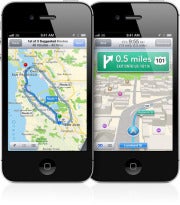
 New Apple iOS 6 mapsApple bought several mapping companies to produce its own mapping product – replacing the Google Maps-powered Maps app.
The main difference between Apple’s and Google’s maps products is that
the first uses resolution independent vector maps, while the latter uses
layered images for each zoom level. The advantage
to Apple’s solution is that you don’t have to wait for blocks to load
as you zoom in, because maps are being rendered live on the phone, which
gives you a smoother experience.
New Apple iOS 6 mapsApple bought several mapping companies to produce its own mapping product – replacing the Google Maps-powered Maps app.
The main difference between Apple’s and Google’s maps products is that
the first uses resolution independent vector maps, while the latter uses
layered images for each zoom level. The advantage
to Apple’s solution is that you don’t have to wait for blocks to load
as you zoom in, because maps are being rendered live on the phone, which
gives you a smoother experience.Like Google Maps for Android, Apple is introducing in its iOS 6 Maps app 3D buildings and turn-by-turn (voice) navigation, but there will be one main thing missing: Google's Street View, which Apple’s app doesn’t feature. Google already has the Earth app for iOS, so it’s entirely possible the company would release a standalone Google Maps app in the App Store, just like it said it would with another soon-to-be-gone iOS app: YouTube
Sayonara YouTube

YouTube for iOSYouTube is the latest Apple-Google collaboration to be spiked from iOS,
Apple confirmed. The video-watching app dates from the early days of
iOS, and there simply won’t be one offered with iOS 6 by default.
Instead, Google said it is developing its own YouTube iOS app, to be
launched in Apple's App Store at a later date.
The lack of a YouTube app probably won’t make a big difference to users. You will be able to watch YouTube clips straight from Safari on the mobile version of the site, instead of having a link open automatically in the YouTube app automatically.
In developing its own YouTube app, Google will also have the ability to introduce advertisements in the app (something not present in the current app), and also update the app with new features more often. In Apple’s hands, the YouTube app has seen very little improvements over the years.
The lack of a YouTube app probably won’t make a big difference to users. You will be able to watch YouTube clips straight from Safari on the mobile version of the site, instead of having a link open automatically in the YouTube app automatically.
In developing its own YouTube app, Google will also have the ability to introduce advertisements in the app (something not present in the current app), and also update the app with new features more often. In Apple’s hands, the YouTube app has seen very little improvements over the years.
Adieu 30-Pin Dock Connector

Apple's older 30-pin connectorThe next-generation iPhone is expected to have a 19-pin dock connector,
a change that could disrupt the accessories market that caters to the
30-pin connector currently found on the iPhone. The current 30-pin
connector has been around since the first iPods, and Apple needs a
smaller connector in order to make the new iPhone thinner and to
incorporate a 4G radio.
However, moving to a new and smaller dock connector won’t be without its problems. While accessory manufacturers slowly start adopting the new plug as new iPhone sales grow, Apple is expected to introduce an adaptor that would make the new iPhone (and later iPads) compatible with the old-style adaptors. However, the new dock connector should also make people less reliant on using wired accessories and push sales of AirPlay-compatible accessories.
However, moving to a new and smaller dock connector won’t be without its problems. While accessory manufacturers slowly start adopting the new plug as new iPhone sales grow, Apple is expected to introduce an adaptor that would make the new iPhone (and later iPads) compatible with the old-style adaptors. However, the new dock connector should also make people less reliant on using wired accessories and push sales of AirPlay-compatible accessories.
Arrivederci microSIM

iPhone 5 probably will use a smaller SIM cardAnother change designed to leave more space inside the new iPhone for components is a smaller SIM card, reports French site nowhereelse.
Smaller, you say? Yes nanoSIMs are around 40 percent smaller than the
microSIM cards introduced with the iPhone 4 (they measure just under
one-half of an inch by 0.35 of an inch by 0.03 of an inch. Apple proposed
this new standard over competing proposals from Nokia and Motorola, and
the new design will offer the same functionality as current SIM cards.
While the smaller SIM card might make a difference for Apple’s internal iPhone design, for users the transition should be quite straightforward. The nanoSIM can be packaged and distributed in a way that is backwards compatible with existing SIM card designs.
Ref:
Pcworld
While the smaller SIM card might make a difference for Apple’s internal iPhone design, for users the transition should be quite straightforward. The nanoSIM can be packaged and distributed in a way that is backwards compatible with existing SIM card designs.
Ref:
Pcworld


0 comments:
Post a Comment